
QuantaPayments
Powering Secure Global Transaction
Supports in this guide: Payments
Provider website: quantapayments.com
What you need to do for start processing transactions (brief summary)
- Choose account type
- Get your credentials (from QuantaPayments)
- Connect in Dashboard
- Send an API request
Choose account type
QuantaPayments can be connected in the following way:
- If you do card payments -> choose H2H Merchant account
If you are not sure which one to use, confirm with your Corefy account manager.
Prerequisites: get from QuantaPayments
Get the following values for your QuantaPayments account:
- Merchant Key -> Corefy field
merchant_key-> where to find: issued by QuantaPayments manager - Secret Key -> Corefy field
secret_key-> where to find: issued by QuantaPayments manager - Api Url -> Corefy field
api_url-> where to find: issued by QuantaPayments manager;
Important
Be sure to check with the manager if you require to provide a white list of IPs, and if so, specify IP addresses from the Corefy list.
Payments processing (connect H2H Merchant account, create payment-invoice)
Connect H2H Merchant account in Corefy Dashboard
Step 1 - Open connection form
Open QuantaPayments in the provider directory and press Connect at QuantaPayments Provider Overview page in the New connection section. Choose H2H Merchant account.
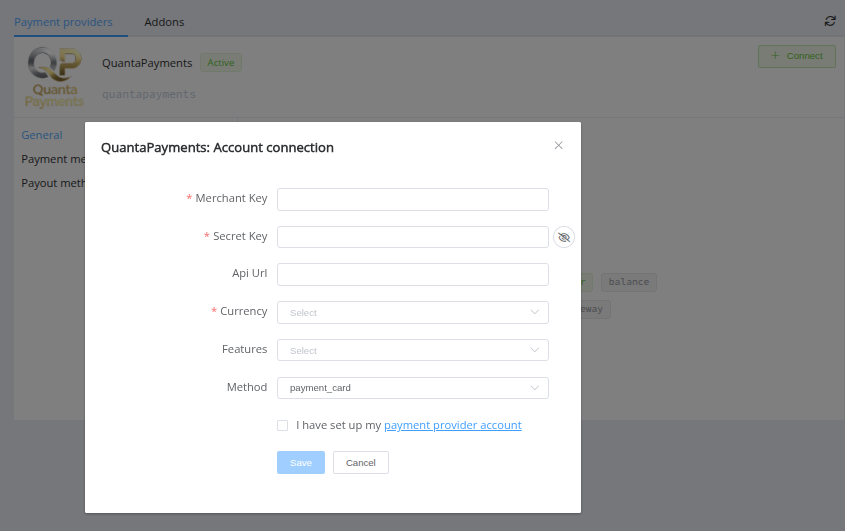
Step 2 - Fill in fields and select settings
- Merchant Key ->
merchant_key(cannot be changed after the connection is created) - Secret Key ->
secret_key - Api Url ->
api_url(optional) - Currency / Features / Method -> choose values available for your account (Method:
payment_card)
Success
You have connected QuantaPayments H2H Merchant account!
First request to Corefy API (MIN)
What it does: creates a payment-invoice.
QuantaPayments requires the customer's name, email, phone and full billing address (address, city, region, post code, country) for every payment. Provide them in the request, or set the matching Constants (see below) on the connection. If the customer's first and last name are not provided, the cardholder name is used.
Payment - MIN
POST /api/payment-invoices
{
  "data": {
    "type": "payment-invoice",
    "attributes": {
      "service": "payment_card_eur_hpp",
      "currency": "EUR",
      "amount": 100,
      "customer": {
        "reference_id": "cus_123",
        "email": "johnsmith@gmail.com",
        "phone": "1234567890",
        "address": {
          "country": "MX",
          "region": "Mexico state",
          "city": "Mexico City",
          "full_address": "123 Main St.",
          "post_code": "12345"
        }
      }
    }
  }
}
Payment - MAX
POST /api/payment-invoices
{
  "data": {
    "type": "payment-invoice",
    "attributes": {
      "service": "payment_card_eur_hpp",
      "currency": "EUR",
      "amount": 100,
      "customer": {
        "reference_id": "cus_123",
        "first_name": "John",
        "surname": "Smith",
        "email": "johnsmith@gmail.com",
        "phone": "1234567890",
        "address": {
          "country": "MX",
          "region": "Mexico state",
          "city": "Mexico City",
          "full_address": "123 Main St.",
          "post_code": "12345"
        }
      }
    }
  }
}
Extended request (MAX)
Why add extra fields (typical reasons):
- Provide additional customer details for compliance/reconciliation
- Positively influence conversion rate
- Include optional fields required by your specific flow
Constants (fallback fields)
Constants are static values that Corefy can send to the provider instead of dynamic data from your API request, when those fields are missing in the request.
After the successful connection, fill in constants for necessary routes in editing menu.
Priority (predictable rule):
- If a value is present in the request -> Corefy uses the request value
- Else if the constant is set -> Corefy uses the constant
- Else -> provider may reject the request or apply its defaults (depends on provider)
Currently available constants (constant -> Corefy API field)
first_name->customer.first_name(if missing, the cardholder first name is used before the constant)last_name->customer.surname(if missing, the cardholder last name is used before the constant)email->customer.emailphone->customer.phonefull_address->customer.address.full_address(orcustomer.address.street)city->customer.address.cityregion->customer.address.regionpost_code->customer.address.post_codecountry->customer.address.country(ISO 3166-1 alpha-2, e.g.MX)
Additional info
- No callback URL setup is required in the QuantaPayments back-office - Corefy sends the callback URL with every payment request.
- If 3-D Secure authentication is required, the customer is redirected to the 3DS page and the payment is finalized after authentication.
FAQ / Troubleshooting
- Invalid credentials / auth error -> verify the Merchant Key and Secret Key issued by QuantaPayments for the chosen environment
- Currency or service is not supported -> confirm allowed currencies/features in your QuantaPayments account and in Corefy
- Missing customer data fields -> provide the customer's name, email, phone and address in the API request, or set constants (see "Constants")
- Not sure which account type to use? -> ask your Corefy account manager
Question
Still looking for help connecting your QuantaPayments account? Please contact our support team!